

Magento
Open Source 2.4.9 GA (and later 2.4.x).
When you run a headless Magento behind an Astro (or other) storefront, the old Luma frontend is still alive underneath — every product, category, checkout and CMS page still responds. That’s duplicate content for Google, a confusing second checkout, and a surface you don’t want exposed. Headless Lock turns the Luma storefront off with a single toggle — while GraphQL, REST and the Admin keep working untouched, and payment and OAuth callbacks keep flowing.
Install Headless Lock with Composer using your AgenticEcom licence key (find it on your My Licences page — one key unlocks every module you own):
# 1. Register the AgenticEcom repository (once per store)composer config repositories.agenticecom composer https://repo.agenticecom.netcomposer config --global --auth http-basic.repo.agenticecom.net <YOUR-LICENCE-KEY> x
# 2. Require this modulecomposer require agenticecom/module-headless-lock
# 3. Apply itphp bin/magento setup:upgrade && php bin/magento setup:di:compile && php bin/magento cache:flushMagento
PHP
Scope
Bypass-proof
Blocked (when on)
Every native frontend page: catalog (products, categories, search), CMS pages, checkout, the customer account, 404s and any unknown frontend route.
Always allowed
GraphQL (/graphql), REST (/rest) and the Admin (/admin) run in their own areas and
are never affected — plus every payment gateway and OAuth/social-login callback.
You decide
Any extra frontend route on your install (a non-standard payment module, /llmstxt, a custom
webhook) can be allow-listed.
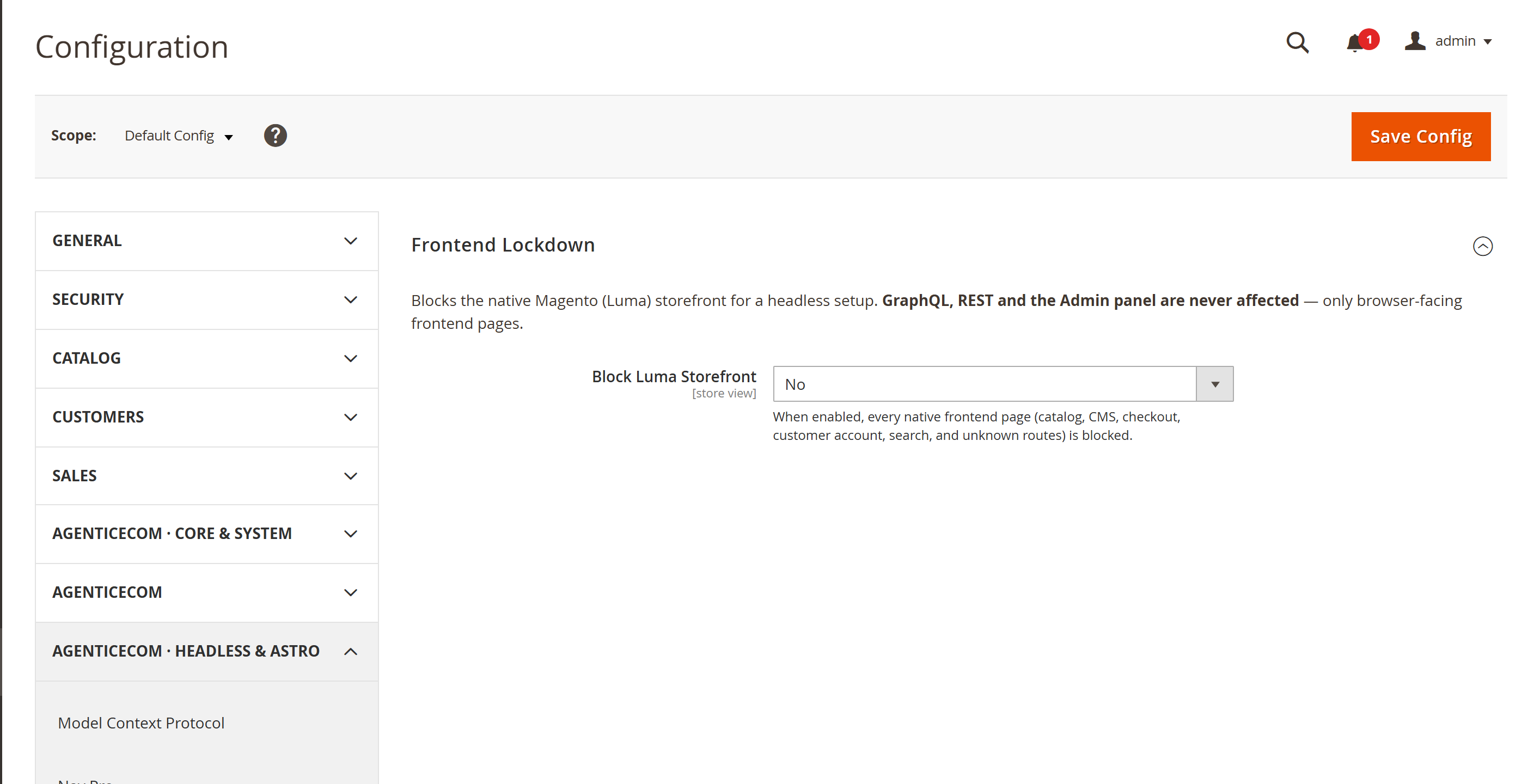
Go to Stores → Configuration → AgenticEcom · Headless & Astro → Headless Lock → Frontend Lockdown. (Pick the store view first if you only want to lock one.)
Set Block Luma Storefront to Yes.
Choose When Blocked:
If you chose redirect, set the Redirect URL to your storefront (e.g. https://yourstore.com). If
it’s left blank, a 410 Gone is returned instead.
Save Config. The Luma storefront is now dark; your APIs, Admin and payment callbacks keep working.
Most stores never need this — payment and OAuth are already covered. Use it only for a non-standard integration.
Allowed Frontend Routes lists every frontend route registered on your install (with its module
name). Tick any extra one you need to stay reachable while the lock is on — for example a
non-standard payment module, or /llmstxt for the AI-crawler file.
Additional Path Prefixes (advanced) takes one path per line (or comma-separated) for callbacks
that aren’t a standard route front-name. A request is allowed if its path equals or starts with a
listed prefix — e.g. /webhook/my-service.
No. The block is frontend-area only. GraphQL (/graphql) and REST (/rest) run in separate
areas and the blocking plugin isn’t even loaded there, so they’re never affected. The Admin is
likewise untouched.
They’re automatically allowed. The payment-gateway routes (Stripe, PayPal, Braintree, Adobe Payment Services, the vault) and OAuth/social-login are hard-coded as always-allowed and can’t be blocked, even if you don’t tick them in config.
The lock only auto-allows the standard gateways. If your module registers a frontend route it appears in Allowed Frontend Routes — tick it. If its callback isn’t a registered route, add its path to Additional Path Prefixes (advanced).
Use 302 redirect while you’re transitioning, so you can point shoppers at the new storefront and still reverse it. Use 410 Gone once you’re certain the Luma frontend is retired for good — it tells search engines to drop those URLs.
Yes. Every setting is store-view scoped. Select a store view at the top of the Configuration page, enable the lock there, then leave the other store views disabled. Verified clean on Magento 2.4.9, PHP 8.4 and 8.5.