

Magento
Open Source 2.4.9 GA (and later 2.4.x).
A headless storefront has to know what its Magento backend can actually do — which extensions are installed, what queries and mutations they add. Schema Discovery answers that programmatically: it scans every module’s GraphQL schema and returns a structured manifest of all queries and mutations (with their arguments, return types and source module), as a GraphQL query or a downloadable JSON — so your Astro frontend can adapt to whatever’s installed instead of hard-coding assumptions.
Install Schema Discovery with Composer using your AgenticEcom licence key (find it on your My Licences page — one key unlocks every module you own):
# 1. Register the AgenticEcom repository (once per store)composer config repositories.agenticecom composer https://repo.agenticecom.netcomposer config --global --auth http-basic.repo.agenticecom.net <YOUR-LICENCE-KEY> x
# 2. Require this modulecomposer require agenticecom/module-schema-discovery
# 3. Apply itphp bin/magento setup:upgrade && php bin/magento setup:di:compile && php bin/magento cache:flushMagento
PHP
Coverage
Output
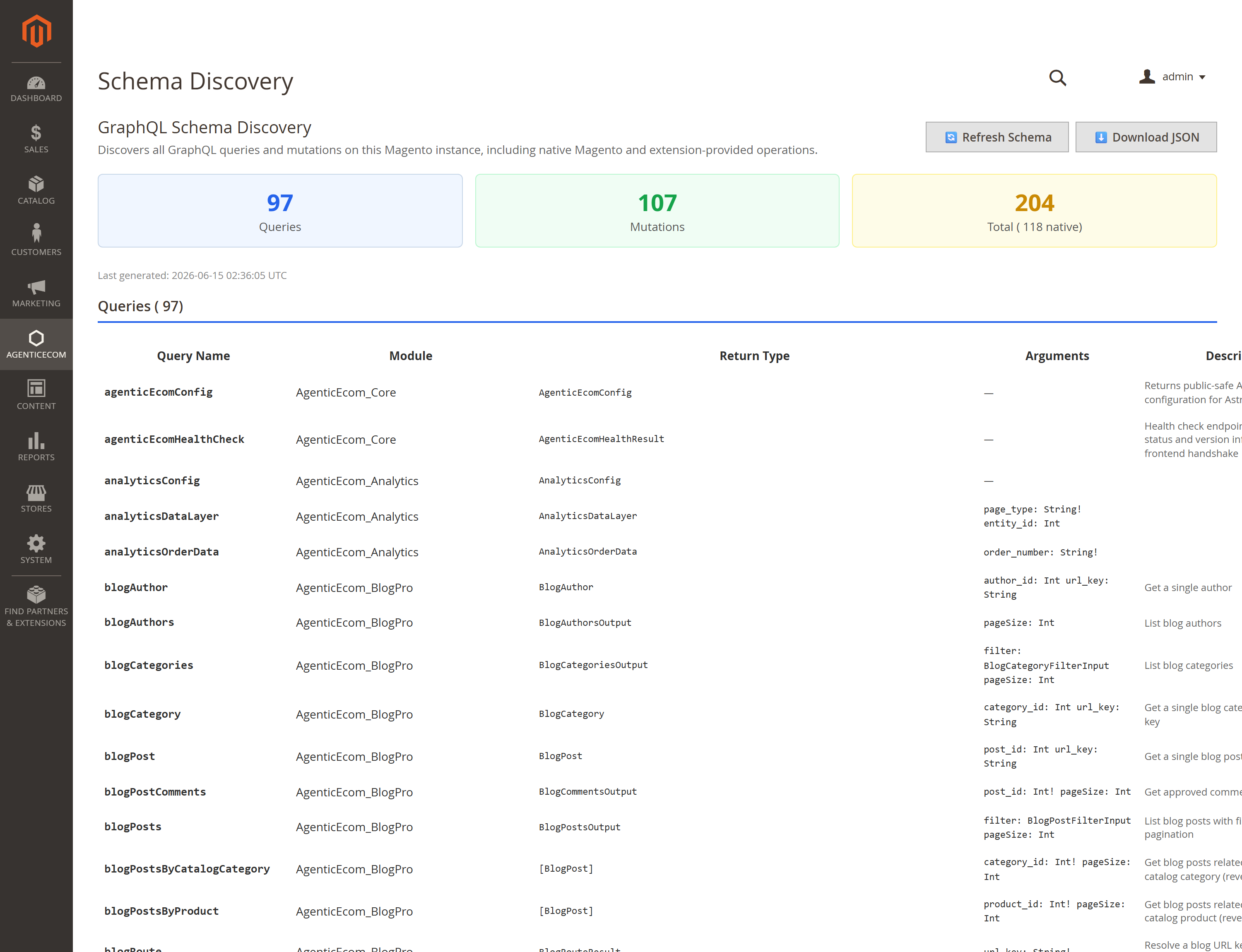
For every Query and Mutation field on the instance, the manifest lists its name, return type, arguments (with required-ness), description and source module — and separates extension-provided operations from native Magento ones, with counts of each.
This is the module’s most important property. Enumerating your whole API surface is useful reconnaissance for an attacker, so access is locked down:
Admin by default
The schemaDiscovery query requires an authenticated admin context. Anonymous access is
OFF out of the box.
Optional shared token
For a headless build to pull the schema without a login, set a Schema Sync Token (≥32 chars)
and pass it as the token argument — compared in constant time. No token, no schema.
Explicit opt-in only
Fully anonymous access exists only if an operator deliberately switches it on in configuration — it is never the default.
Admin download
The Download JSON action is permission-gated, so an operator can always grab the manifest offline even with the public query disabled.
Open AgenticEcom → Sync Data → Schema Explorer to see the live counts and a searchable table of every query and mutation, then Download JSON for your build pipeline. (The admin menu entry is labelled Schema Explorer.)
{ schemaDiscovery(token: "your-32+char-sync-token") { total_query_count total_mutation_count queries { name type module args { name type required } } mutations { name type module } }}Returns extension operations first, with native counts alongside.
No — schemaDiscovery requires an admin context by default. A headless frontend can authenticate
with a shared sync token (32+ characters, constant-time compared), and fully anonymous access only
exists if you explicitly enable it. The secure default is admin-only.
No — it reads the GraphQL schema definition files modules ship and reports the query/mutation API surface only. No catalogue data, config values or DB schema are ever included.
So it can adapt to whatever’s installed — discover that BlogPro adds blogPosts, or that a feed
module adds its mutations — and enable the matching frontend features automatically, instead of
hard-coding which extensions exist.
It extracts fields directly from the SDL with a brace-tracking parser rather than a strict GraphQL parser, so the dozen core files that use placeholder types or cross-file references don’t break discovery. Verified clean on PHP 8.4 and 8.5.